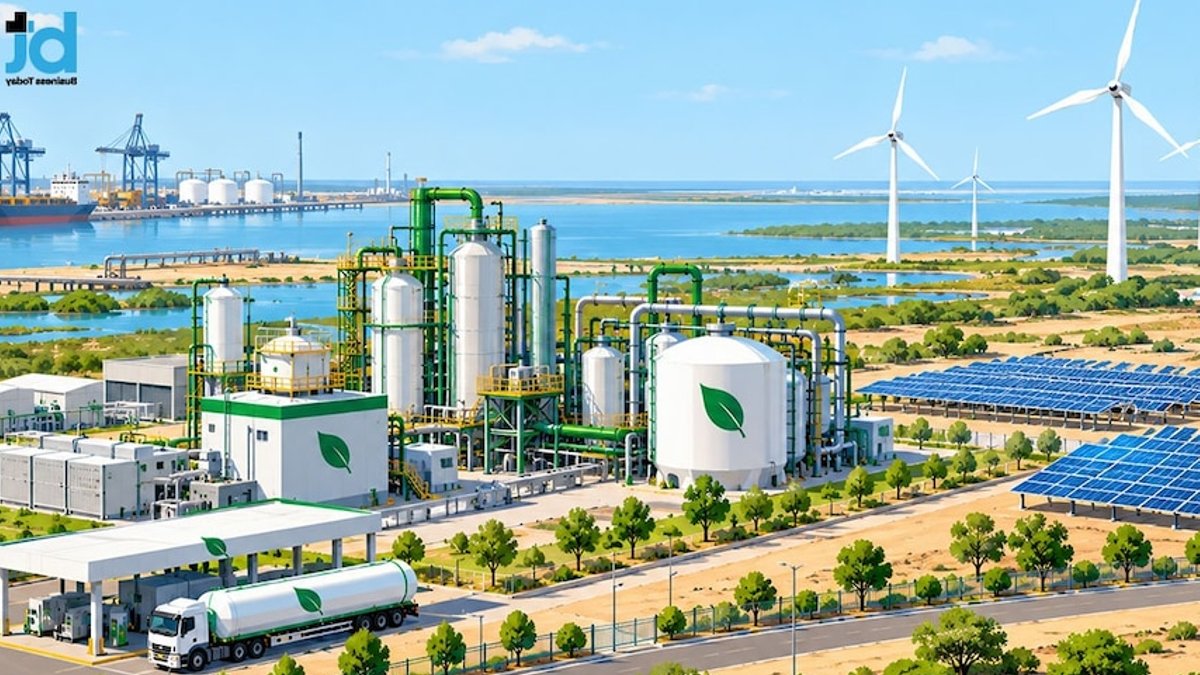
India’s efforts to establish itself as a global leader in green hydrogen production face a critical shortfall: demand. Since Prime Minister Narendra Modi unveiled the National Green Hydrogen Mission (NGHM) in 2023, the country’s expansion in production capacity has outstripped actual consumption, leaving financial incentives unutilized and industry plans scaled back.
The government’s Strategic Interventions for Green Hydrogen Transition (SIGHT) scheme allocated ₹17,490 crore in January 2023—₹4,400 crore for electrolyser manufacturing and ₹13,050 crore for production. However, no funds have been disbursed because the incentives require actual output, which remains stagnant. Major companies are now reconsidering their investments.
Larsen & Toubro (L&T) has paused plans to expand its Gujarat electrolyser capacity from 400 MW to 1 GW. Both Reliance Industries and Adani Group, which had announced projects of 3 GW and 5 GW respectively, have slowed construction. Reliance’s goal of producing 3 million tonnes by 2032 remains on hold, with no expected progress before 2028 or 2029.
Cost barriers stall green hydrogen adoption
The core issue is cost. Industry leaders state that this price difference makes adoption impractical for sectors like refineries and fertilizer plants, where switching would double expenses. Additionally, road transport and shipping face infrastructure gaps that delay adoption.
The NGHM’s target of producing 5 million tonnes by 2030 depends on demand from refineries, fertilizer production, city gas, steel, and transport. However, the mission’s demand creation policies, including mandates for green energy use, remain unimplemented. Without enforceable consumption targets or penalties, industries have no motivation to transition.
Nishaanth Balashanmugam, CEO of Green Hydrogen India (GH2 India), describes this as a systemic challenge. He argues that subsidies alone cannot drive adoption; the government must impose green hydrogen usage mandates, similar to those in the European Union. His recommendation includes 10% annual transition targets for industries, either voluntary or mandatory, to create market stability. The industry is not currently seeking penalties for defaults, as mandates would provide better visibility and certainty for the sector.
A similar mismatch occurred during India’s solar PV expansion, where manufacturing outpaced actual demand. A 2026 report by the Institute for Energy Economics and Financial Analysis (IEEFA) found that 94% of planned green hydrogen projects remain unbuilt, with only 2.8% operational. The main obstacles are lack of buyers, high costs, and insufficient storage and transport infrastructure.
Export plans face global certification hurdles
Exports, another NGHM priority, face significant obstacles. While the mission aims for 10% of global demand by 2030, the Hydrogen Council reports that 90% of global projects, totaling $130 billion and 6.9 million tonnes annually, are already operational or under construction. India’s ₹17,490 crore in unused SIGHT funds suggests domestic demand is the primary constraint.
Even if production increases, export challenges persist. The EU’s certification standards, which require new renewable energy, hourly production-consumption matching, and geographic correlation, conflict with India’s 2025 certification plan, which only tracks carbon emissions. Without aligning these rules, Indian green hydrogen may struggle to enter key markets.
For sectors like refineries and fertilizer plants, the shift from grey to green hydrogen remains economically difficult. India currently produces 6.5 million tonnes of grey hydrogen annually, mostly for internal use. Switching to green hydrogen would double costs for refineries and increase expenses by 1–1.5 times for fertilizer producers. Beyond cost, road transport and shipping lack refueling infrastructure, and engine modifications, ranging from minor adjustments to full redesigns, are unresolved. Even with NGHM cost reductions, from $5–6 per kg before the mission to $3.5–5 per kg without subsidies and $2–3.75 per kg with them, green hydrogen remains far pricier than grey hydrogen’s $1.9–2.5 per kg baseline.
Operational electrolyser capacity stands at just 65–70 MW, far below the announced 25 GW target, while green hydrogen production remains around 12,000 tonnes, far short of the mission’s 11.2 million-tonne goal. The delay in L&T’s 100 MW electrolyser order for Indian Oil’s Panipat plant reflects broader industry challenges: announced capacities exist only on paper, with no real production. The SIGHT scheme’s structure, which ties incentives to output, not planning, has left ₹17,490 crore unclaimed as projects stall.