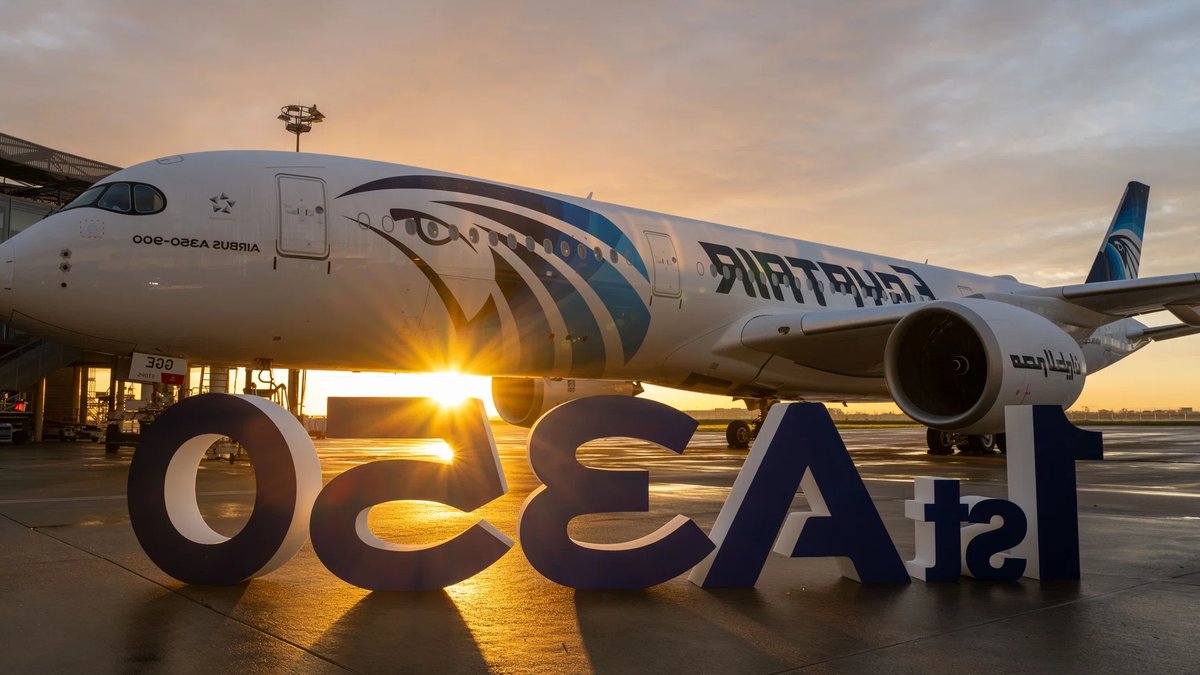
EgyptAir will become the sixth airline to operate on the Singapore‑Sydney corridor, joining a wave of carriers that are expanding seat capacity on one of the region’s busiest long‑haul routes.
Fifth‑freedom service adds a new player
The North African carrier plans to launch fifth‑freedom flights that connect the two cities, a right that lets an airline serve a route between two foreign nations even though the flight starts or ends in its home country. British Airways and Turkish Airlines already run such services, while home‑market operators Singapore Airlines (SIA), its low‑cost arm Scoot, and Qantas dominate the market.
According to travel data provider OAG, the link currently hosts 67 weekly flights. EgyptAir’s entry is slated for early 2027, and the airline will operate an Airbus A350‑900 with a 30‑seat business cabin and 310 economy seats.
That adds roughly 90 to 120 business seats per week each way, a single‑digit rise on a route that already offers more than 2,000 weekly business seats. The airline’s cabin will be two‑class and alcohol‑free, a configuration that differs from SIA’s multi‑class, high‑yield product.
Capacity surge and airline strategies
In the past 12 to 18 months, airlines have loaded unprecedented capacity onto the corridor. SIA is boosting its seat count to Sydney to a record level and will open a new service to Western Sydney International Airport. Qantas, meanwhile, is up‑gauging six of its weekly rotations to four‑class Airbus A380s by December.
Turkish Airlines is set to start its own fifth‑freedom A350 service via Singapore in October. The combined effect is a rapid expansion that has prompted analysts to describe the demand signal as “unambiguous.”
Mayur Patel, head of Asia at OAG, said the market is pulling premium leisure, visiting‑friends‑and‑relatives, and corporate traffic in volume. He noted that a fourth daily A380 flight between SIA and Qantas is expected by year‑end.
Market impact and pricing trends
Analysts view the EgyptAir addition as a by‑product of a broader network strategy linking Cairo with Australia, rather than an effort to capture new demand on the Singapore‑Sydney route. New South Wales alone hosts more than 21,000 residents of Egyptian heritage, offering a modest passenger base.
Point‑to‑point traffic between Cairo and Singapore remains thin; SIA withdrew its own Cairo‑Dubai‑Singapore service in 2014 after a 60 % drop in demand. Linus Benjamin Bauer of BAA & Partners said Cairo‑Singapore alone doesn’t support a wide‑body aircraft.
EgyptAir’s Sydney leg serves as a commercial sweetener to monetize spare capacity on the long rotation. The added seats are unlikely to threaten the incumbents, whose deep corporate accounts, high flight frequencies, and established loyalty programmes give them a solid foothold.
Instead, pricing pressure is expected to fall on fellow fifth‑freedom operators British Airways and Turkish Airlines, which rely on intermediate travelers to fill residual seats. “Fifth‑freedom seats are priced to clear, so the fare impact will run ahead of the raw seat share,” Bauer explained, noting that leisure fares may compress without destabilising the route’s fundamentals.
Patel added that the overlap of carriers highlights Singapore’s liberal fifth‑freedom stance, which encourages competition across alliance lines. The three Star Alliance members on the corridor—SIA, Turkish Airlines and EgyptAir—operate without a joint venture to coordinate capacity or pricing.
SkyTeam remains absent from the link, and analysts consider a SkyTeam entry unlikely because its major Asian and European carriers typically route Australia‑bound traffic through their own primary hubs rather than through Southeast Asian waypoints.
Changi Airport said on September 10 that demand for travel between Egypt and Australia, as well as Southeast Asia, remains “robust and growing,” identifying Egypt as the largest unserved African market for both Singapore and Australia in 2025.
EgyptAir has not responded to requests for comment.