On 4 June 1947, Lord Mountbatten told a press conference in New Delhi that British rule would end on 15 August. Only months earlier, Britain had announced that power would be transferred by June 1948. The subcontinent now had less than ten weeks to prepare not only for freedom, but also for Partition and the birth of two dominions. The compressed timetable placed an extraordinary burden on administrators and political leaders. Borders had to be drawn, governments constituted, assets divided and the future of hundreds of princely states determined. Some of the most revealing episodes from those anxious weeks remain less widely remembered.
The task of drawing the new boundaries through Punjab and Bengal was entrusted to Sir Cyril Radcliffe, a British barrister who had never previously visited India. He was given little more than five weeks to complete one of the most consequential cartographic exercises in modern history. Radcliffe submitted his boundary awards on 12 August 1947. Their publication was, however, withheld until 17 August. Consequently, millions of people entered independence without knowing with certainty which country their homes, villages or fields would fall within.
Related: Rupee Holds Steady At 95.70 Despite Crude Pressure
The confusion was immense. Communities discovered that the political geography around them had changed overnight, sometimes placing homes in one country and agricultural land or markets in another. Radcliffe left India on 18 August and never returned. Before leaving, he destroyed his working papers and reportedly declined his £3,000 fee, appalled by the bloodshed accompanying Partition. Yet the border was only one part of the uncertainty. An equally formidable challenge was determining the future of the princely states.
Integration of Princely States
When British paramountcy lapsed, more than 560 princely states were no longer bound by their earlier arrangements with the Crown. Their rulers were encouraged to accede to either India or Pakistan, principally on matters of defence, external affairs and communications. By 15 August, the overwhelming majority had signed instruments of accession. Important exceptions remained. Maharaja Hari Singh of Jammu and Kashmir had not chosen either dominion. Hyderabad sought to remain independent, while the Nawab of Hindu-majority Junagadh opted for Pakistan.
Travancore, Jodhpur and Bhopal had also, at different points, resisted accession or explored the possibility of independence before eventually signing. The prospect of India emerging as a patchwork of sovereign or semi-sovereign territories was not entirely fanciful. Investigative journalist Josy Joseph’s recent book, Birth of a Nation: The Twenty-One Days That Made India, reconstructs the intense negotiations between 25 July and 14 August. It describes the pressure brought to bear on the princes and the urgency with which Indian leaders approached the possibility of political fragmentation.
Related: Carrick asks United board for more signings
Jawaharlal Nehru was unequivocal about the need for national unity. Vallabhbhai Patel and the newly created States Department combined persuasion, constitutional guarantees and political pressure. Central to that effort was V. P. Menon. Having risen from modest clerical work, Menon became one of India’s most accomplished constitutional officials and Patel’s principal aide in negotiating with the princes. His own account of the process shows how integration required not merely legal instruments, but patience, guarantees and careful management of royal status and ego. The crises involving Junagadh, Hyderabad and Jammu and Kashmir unfolded after 15 August. Their consequences did not end in 1947, particularly in the case of Kashmir.
The Midnight Session
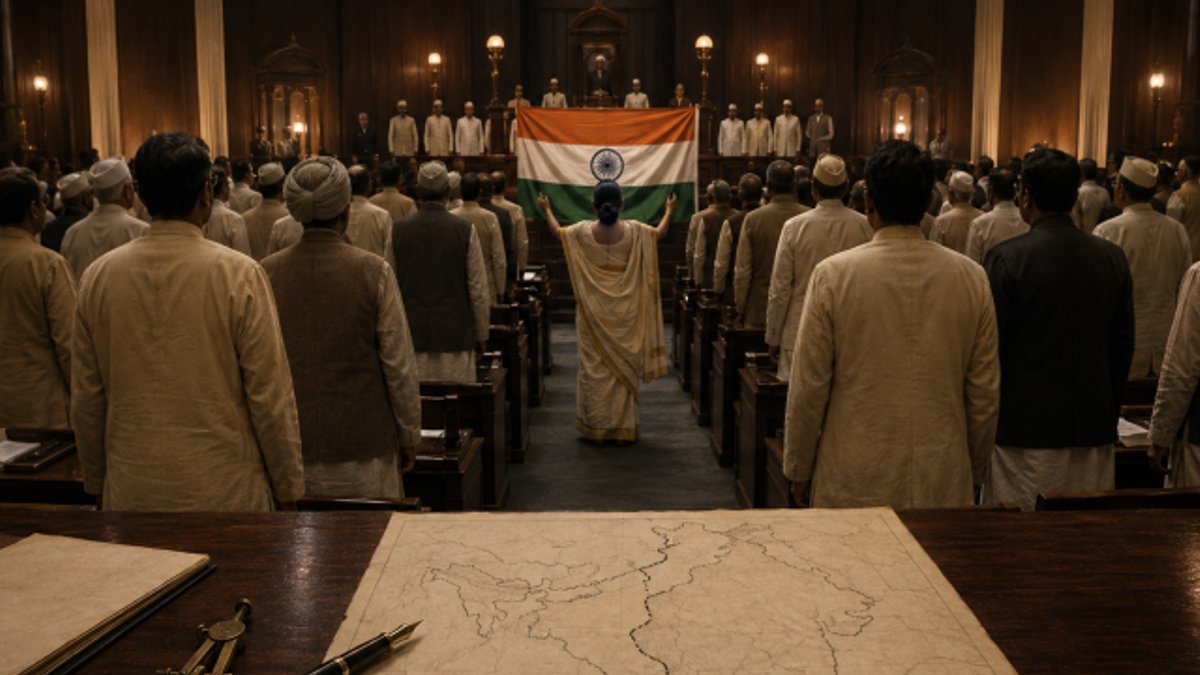
This was the unsettled political setting against which the Constituent Assembly met in Delhi on the night of 14–15 August. The Assembly convened at 11 p.m. Sucheta Kripalani opened the proceedings by singing Vande Mataram. Assembly President Rajendra Prasad then remembered those who had sacrificed their lives during the freedom struggle. Jawaharlal Nehru moved the pledge that members would take at midnight and delivered his celebrated “Tryst with Destiny” address: “At the stroke of the midnight hour, when the world sleeps, India will awake to life and freedom.”
The speech was not an uncomplicated celebration. Nehru acknowledged that grief accompanied freedom and that cities close to Delhi were already burning. Other voices that night also deserve to be remembered. Muslim League leader Chaudhry Khaliquzzaman urged the new government to act without communal consideration or favour. S. Radhakrishnan described the transfer of power as orderly and dignified, but warned that independent India would henceforth have to accept responsibility for corruption, nepotism, profiteering and administrative failure. At midnight, the members stood and took a solemn pledge dedicating themselves to the service of India and its people.
Related: Nigeria needs proactive governance approach
The Assembly then endorsed the recommendation that Mountbatten serve as independent India’s first Governor-General and authorised Rajendra Prasad and Nehru to convey its decision. Hansa Mehta next presented the national flag to the Assembly on behalf of the women of India. Sucheta Kripalani concluded the proceedings by singing the opening lines of Sare Jahan Se Achha and the first verse of Jana Gana Mana. According to Mountbatten’s later account, a moment of unintended comedy intruded upon the solemnity. Nehru ceremoniously handed him an envelope that was supposed to contain the portfolios of his new Cabinet. When Mountbatten opened it, he found only a blank sheet. The correct list was subsequently supplied.
India therefore entered freedom with its border unpublished, parts of its political map unresolved and communal violence spreading across the land. Its freedom was real, but certainty was not. What followed was an experiment in democracy that frequently appeared untidy, argumentative and chaotic, yet proved remarkably resilient. India did not awaken to a finished nation. It awakened to the responsibility of building one.